Our freedom and collective survival require that we relinquish the forms of false belonging and internalized superiority that have long organized society and rededicate ourselves to the difficult, joyous, and lifelong process of relearning our true belonging to each other and the Earth.
The Polycrisis and Belonging
The mass death, injustice, isolation, and disintegration that characterize the 21st century are sustained by the renewed vilification of specific social groups, and a correspondingly pervasive absence of real belonging.1 To reverse this epochal, manifold crisis requires understanding that psychological and interpersonal dynamics are always co-determined by political economy, world-history, social institutions, and changing planetary ecologies. In other words, the individual psyche has everything to do with all of the material activities through which we make (and destroy) human lives and societies across scales of time and space.2 Repairing the world requires that we radically change both the organization of collective life and the individual self simultaneously.3
Belonging refers to the formation of stable, pleasurable interpersonal attachments and concomitant feelings of connection to and inclusion within a social group – being an integral, respected, and valued part of a community. Contrary to the claims of neoliberal elites and the hyper-individualist messages of the dominant culture, human beings have an intrinsic and fundamental need to belong 4, as evidenced by the fact that the absence of social connection leads to premature morbidity and death, while positive and deep relations sustain human well-being.5
The experience of belonging differs according to our diverse and intersecting social positions, but the desire to belong to and with other people occurs universally across the human species. The longing for togetherness has roots within the psyche that reach indescribably deep. Human beings are inescapably made and remade through social ties. Our nervous systems have been shaped across the span of evolutionary time to facilitate incredibly delicate, multilayered, and rich forms of interpersonal communication and resonance.6 Thus, we are often more inclined to compromise our moral values and genuine self-expression than to sever our relational attachments or our belonging to a social group.7
False belonging refers to forms of social inclusion that are premised on norms of internalized superiority and the ostracization, devaluation, or killing of groups construed as inferior or subhuman. In this case, the physical and discursive practice of othering produces rigid distinctions between those who belong to the superior, structurally advantaged groups and those who do not.8 Empowered, dominant social groups function through conformity, homogeneity, and the punishment of divergence. Culturally, they are depicted and seen as better, higher, purer, and more human. In contrast, subordinated social groups cohere around the historical memory of marginalization, but also the commonality of survival, resistance, and revolution. They are typically excluded from assumed belonging and regarded as lesser, lower, impure, and inhuman.

Capitalist Violence and False Belonging
Capitalist society intrinsically requires the destruction and control of human and nonhuman relations, and the imposition of ways of living that are antithetical to real and just relationships between people or between humans and the rest of the planet. To prevent the unity, solidarity, and rebellion of working people, the ruling class must internally divide and hierarchize the mass of the population, and this involves the promotion of forms of social cohesion and group consciousness that denigrate an inferior “other”.
The capitalist state disconnects human and nonhuman beings from each other and then re-enters atomized lifeworlds as the only kind of linkage possible, consolidating hierarchies that disallow non-capitalist ways of experiencing a common life.9 We can therefore understand the oppressive forms of differentiation (such as race, gender, and nationality) that structure modernity as technologies of social control that serve the owning classes.10
capitalist society intrinsically requires the destruction and control of human and nonhuman relations
More materially, the coercive drive to accumulate capital enforces the separation and ranking of human and nonhuman communities according to hierarchies of worth. Symbolic-material partitions between “superior” and “inferior” are necessary to maintain exploitative social relations because they naturalize the mass objectification of human and nonhuman beings. The systematic devaluation of groups such as women, Indigenous Peoples, Black communities, and animals allows the capitalist class to secure, rationalize, and harness the prodigious amounts of free (stolen) or cheap (waged) labor-power, land, and life-energy that are necessary for accruing capital.11 To offer concrete examples:
- The state of Colorado alone was built on $1.7 trillion of land expropriated from Indigenous nations, and since the mid-19th century, over $540 billion worth of minerals have been extracted from the territories of Colorado tribes.
- The forced labor of enslaved Black people contributed $5.9 trillion to the U.S. economy.
- Around the world, women and girls perform $3.6 trillion worth of social-reproductive work annually without pay.
- Climate change-attributed costs of extreme weather average $143 billion annually. Polluting industries displace the cheap and/or free labor of caring for damaged ecosystems and communities onto women, peasants, and Indigenous Peoples.

The capitalist system requires that certain human activities be paid and especially valued, while the vast majority of human and nonhuman natures get put to work for free or very low-cost. The use of false belonging (a psychological instantiation of social hierarchy) helps the capitalist class to transfer most of the real costs of mass-producing commodities and reproducing human life ‘outside’ of the formal wage economy.
The dominant ways that people understand the social world and each other (namely, through exclusionary forms of togetherness) cannot be separated from the literal organization of life on Earth around the maximization of profit for the few at the expense of the many.
To rephrase: the harmful ways that we treat other beings as inherently alien and inferior are the contingent historical products of capitalist modernity, forged through generations of symbolic, psychological, and physical violence visited on humans and the rest of the living world.
False Belonging #1: White Supremacy
The contested and changing material interests of the global ruling classes profoundly shapes the intensity, expression, and organization of racial discrimination and hostility. The system of white supremacy integrally involves the complicity of individual white people, who are conditioned to dehumanize and kill People of Color. But these psychological and interpersonal dynamics occur within the expansive context of historical and contemporary class warfare, colonial dispossession, and state violence. As Black, Indigenous, and decolonial Marxists argue, racial hierarchies are not sustained merely by individuals, but by the fundamentally inequitable economic and political structures of the capitalist world-system.12 The dominant culture justifies and reproduces the inequalities “that are inescapably part of capitalist social relations” through the use of “fictions of differing human capacities, historically race”, writes Jodi Melamed.13
The transatlantic slave trade and the settler-colonization of the “New World” (and other Indigenous territories), driven by the pursuit of profit, globalized and intensified the racial practices inherent to the capitalist mode of production. The myth of a superior “white” race developed as a division was constructed between the racially pure, civilized, and capitalist domain of Euro-America and the inferior, benighted masses of non-European humanity.14
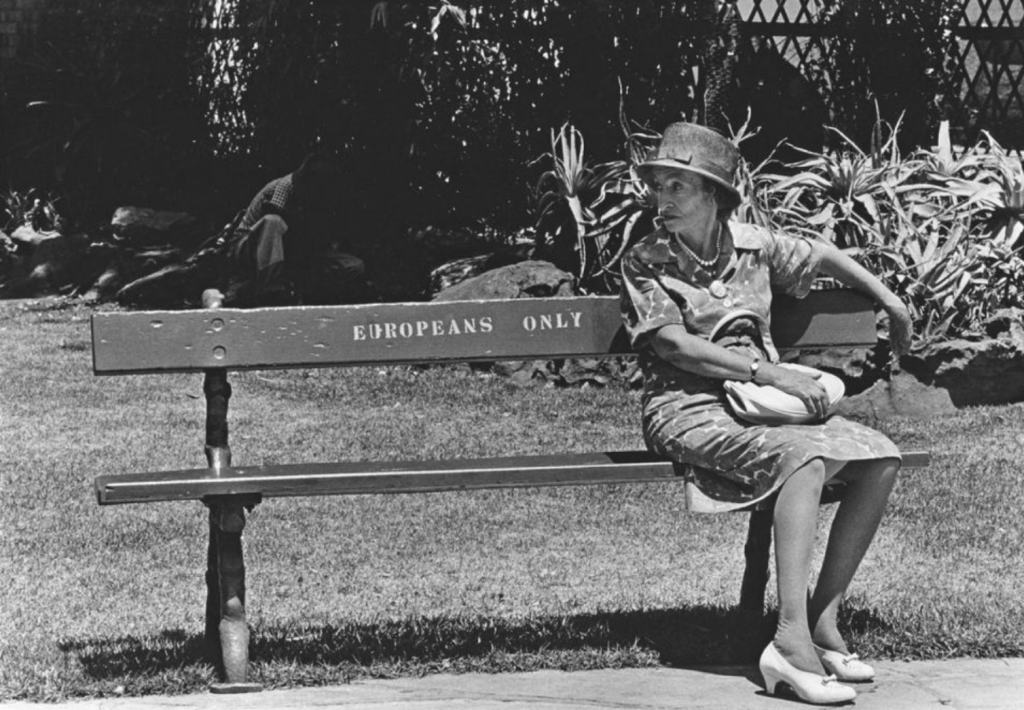
A capacious materialist analysis reveals that conjoined social, economic, and political forces determine the meaning of “race” and that individual psychologies are inseparably enmeshed with historical and ongoing forms of social hierarchy and exploitation. In short, white supremacy requires both the inequitable distribution of social resources and the mass psychology of white superiority.
The psychotherapist Resmaa Menakem argues that white racial superiority can be conceived of as a complex of historical traumas, transmitted across generations of white bodies and physically re-inflicted by white people over and over.15 Many of the European people who traversed the Atlantic to perpetrate colonization had witnessed violence and death before invading the Americas. Or they were the descendants of people that had been exposed to great collective traumas during the Late Medieval period (1300-1500) or the long 16th century (1450-1650). Contemporary white people have far-reaching ancestral traumas to begin healing, including the intergenerational transmission of moral injury: the persistent negative moral emotions like guilt, shame, contempt, and anger that arise from the violation of deeply held values.16
racial hierarchies are not sustained merely by individuals, but by the fundamentally inequitable economic and political structures of the capitalist world-system
The revolutionary sociologist W.E.B DuBois argued that white supremacy operates partly through gaining the class collaboration of white working people by offering them a public and psychological wage: the ability to degrade, kill, and economically exclude Black people with impunity.17 White citizens are “bought off” with the myth of white superiority as well as the concrete benefit of better material conditions than Black people. Various white privileges “purchase” whites’ systematic betrayal of interracial class solidarity, exerting a counter-revolutionary force on the proletariat. But, to reiterate, white racial dominance flows both from the ruling classes (and all the state and cultural machinery that they control) and from civil society – white people that perpetuate the denigration of Black, Indigenous, and other People of Color.18
White settler-citizens are obviously not the central victims of systematic racial domination, but every form of internalized superiority necessarily excises life and humanity from the group deemed “superior”. White supremacy relentlessly conditions white people to:
- Disconnect from, fear, and mistreat most people on Earth, people we might otherwise form authentic, mutual, and loving bonds with.
- Prioritize competitive self-interest, material possessions, and isolation over community.
- Treat the web of life as an external, inanimate collection of resources to be exploited or owned, severing us from nonhuman beings and the land that sustains us.
- Ignore the loss of connection to the histories, cultures, traditional practices, and place-based customs of our ancestors that resulted from conforming to a homogeneous whiteness.
- Protect and support morally indefensible acts and systems out of fear of losing white comfort or being disturbed by a racialized ‘other’.
Conformity with the false belonging of white superiority prevents white people from being free and from truly belonging to the living world and other people. To be clear, confronting our own personal discomfort, trauma, and ingrained ideas around race will not vanquish the racial capitalist state.19 Defeating white entitlement has to transcend the confines of individual self-improvement: our practices of solidarity must deepen as we renounce the idea that we are separate from and better than others.
Taking accountability for and repairing the intimate expressions of our own white supremacist upbringings has to be interwoven with a devotion to comrades and organizations fighting to build power and end racial injustice, colonial violence, imperial war, and genocide. In the context of shared struggles to remedy group-differentiated vulnerability to premature death, white exceptionality dissolves.20
False Belonging #2: Patriarchal Masculinity
The quotidian craving to falsely belong to a superior group also applies to patriarchy and hetero-masculine dominance, which co-opt cisgender males to degrade life for people of all genders and uphold the intimate and collective structures of class society. Men that embody hyper-masculinity and heteronormativity are compensated with a sense of internalized supremacy, greater wealth, and access to the bodies and coerced labor of women, girls, and gender nonconforming people.
In exchange for these “wages of masculinity“, however, controlling notions of male selfhood and power wreak profound damages on the lives, bodies, and relations of men of all sexualities. Patriarchal socialization and binary gender thwart the emotional, social, erotic, and physical freedom of males.21 The internalization of patriarchy dispossesses men en masse from the ability to fully experience and share emotion, to authentically connect, and to experience love.22
For every divergence from the ideals of hetero-masculinity, males receive the hidden punishment of shame, self-loathing, and personal deficiency. Gendered dominance operates partly by weaponizing and replicating that fear – that not sufficiently performing manhood will lead to social rejection, humiliation, and failure. Hetero-patriarchy institutes a false belonging that empowers and privileges while instilling a “terror that gnaws at the soul” and a “deep inner misery” within men.23 To renew loving relations, political solidarities, and authentic selfhood, men of all sexualities must relinquish patriarchy.
Gender and Capital
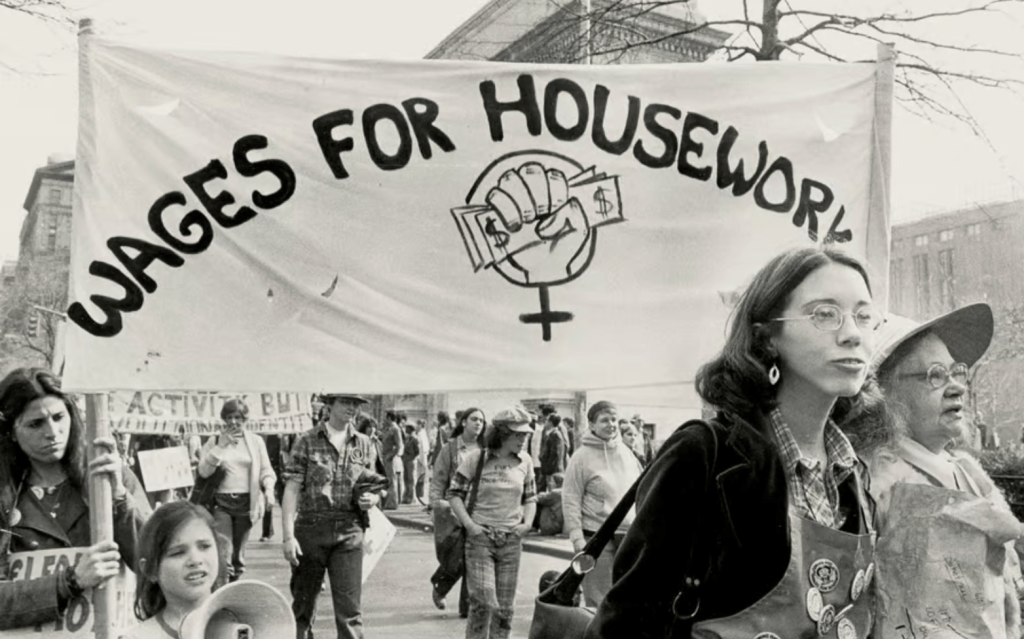
The oppression of women and LGBTQIA+ people might appear to be an incidental addition to the “purely economic” operations of the capitalist state. However, women and other feminine subjects are routinely expected and forced to perform the (non-waged) emotional, sexual, relational, and physical labors necessary to reproduce human and earthly life. The burden of subsistence, care, and domestic work still falls overwhelmingly on women and girls, particularly those from poor and racialized groups.24
In a Marxist sense, these caregiving and social-reproductive labors are not value-producing, but they are a necessary precondition for the existence of wage-relations, commodity markets, and the realization of surplus-value.25 They are also increasingly becoming the dominant form of labor on Earth.26
Family, Heteronormativity
The extraction of social-reproductive labor from women, girls, and feminine people requires the ideological and economic institution of “the family”. Although only a minority of U.S. families are technically “nuclear”, the majority of American households are still organized around monogamous, heterosexual marriages.27 Further, racial capitalist rule and neo-fascist resurgences both continue to mobilize an “American Dream” that idealizes heteronormative, non-communal families ruled by patriarchal males.28
The norm of The Family reinforces class domination by:
- displacing the daily and intergenerational work of reproducing human life and society onto women, girls, and people of oppressed genders, naturalizing the gendered division of labor.
- facilitating the disciplining and “proper” socialization of future wage-laborers and caregivers.
- using forms of intimate terror/violence to instill binary gender norms and forms of male supremacy that reinforce broader structures of inequality and social domination.
- mediating the intergenerational transmission of private ownership and monopolized wealth.
- punishing, eliminating, and foreclosing forms of love, relationship, kinship, and self-expression that subvert racial, colonial, and capitalist rule.
The accumulation of capital therefore requires the foreclosure of queer and gender-expansive worlds that subvert familial and relational norms that reinforce the separation and exploitation of proletarian bodies. Queer sociality defies the individualized, privatized organization of social reproduction, reconstituting care as a potentially joyful labor at once intimate and collective.29 In the expansive ways that LGBTQIA+ people attend to, befriend, and love the flesh of others, there pulses an “incipient communization”, a rehearsal of the lifeways required for making a just society on a damaged Earth.30

Queer feminist consciousness and practice are potent medicines for healing the internalized gender normativity of women, girls, gender-expansive people, and men. Only the reconfiguration of masculinities around true belonging to and with people of all gender variations will free us.
False Belonging #3: Coloniality and Empire
“El sur está aquí al lado.”
The South
Is here, at our side.– Boaventura de Sousa Santos.31
In the Global North, individual worth, personal fulfillment, and societal development are organized around relentless productivity and mass consumption. Such an imperial mode of living both requires resource extraction, environmental ruin, and super-exploitation across the Global South, and confines Western people to a deeply miserable and isolating way of life – a social order antithetical to solidarity, human flourishing and planetary habitability. Diligently supporting the liberation of the poorer, subjugated nations should therefore be seen not only as an ethical duty, but as imperative for materially and psychologically dismantling the toxic false belonging of imperial subjectivity.
In a vast “extractive circuit” of global value chains, 21st century capitalist and imperial power links the dispossession and ecological degradation of Southern and Indigenous worlds with the exhaustion and precarity of the Northern working-class. For example:
- Rare earth minerals violently extracted from the Congo enter manufacturing chains across China, India, and Vietnam, where workers produce the digital technology that will be shipped overseas to exploit, marketize, and surveil Northern labor.32
- The Israeli military company Elbit Systems, which facilitates the high-tech racial persecution and genocide of Palestinians, also contracts with U.S. Border Patrol to maintain surveillance towers on the Tohono O’odham Nation, monitoring Indigenous people and forcing migrants to use more dangerous routes to cross the U.S.-Mexico border.33
Empire operates through the differentiation of races, places, and economies, affecting all bodies and livelihoods differently, hugely privileging the white colonial metropoles over formerly and currently colonized nations. But the channeling of human and nonhuman energies within and through the web of life towards profit maximization breaks communities, planetary boundaries, and zones of habitability everywhere. Every bomb dropped on the people of Gaza brutalizes my own humanity, and further pollutes an already overheated, toxic planet that I myself must also live within.
True belonging – as practice, affect, and aspiration – holds fast to the inseparability of our lives, worlds, and struggles for freedom.
Settler Ways of Death
Colonization and chattel enslavement reconstituted the living geographies of the planet as alienable parcels of economic territory to be rationally managed for concentrated power and profit. Representing the Earth as homogeneous, divisible space upon which the events of linear historical time unfold allowed early modern empires like the U.S. to violently remake the world.34
Colonial projects and socialization processes intergenerationally altered people’s understanding of the very meaning of human life and civilization. The settler-colonial way of life depends integrally, for example, on the objectification of the living world, extirpating the flourishing that can only arise from reciprocity with other beings.35 All peoples’ belonging to and with earthly life degrades as the societies of land-based Indigenous Peoples are replaced with an insatiable economy that devours the planet and human well-being.36

Colonial settlement, industry, and state-building depend upon the destruction of Indigenous Peoples and lifeways. This project of ruthless elimination requires the settler state to deputize white citizens with death-making powers through mythic promises of individual proprietorship and freedom. (The 2nd Amendment, for instance, legalized genocidal warfare against Indigenous nations and Black people through settler militias and armed whites.37) The Conqueror exchanges human and ecological solidarity for the poison wages of coloniality.
Endowed with colonial privileges built on expropriated Indigenous life, settlers uphold the domination of the Earth by a ruling class that accrues wealth and power through extractive industry, imperial warfare, and biological annihilation.
To refuse and oppose the actual return and reclamation of Native lands, waters, and sovereignty means to ensure the continued degradation of life on Earth for all peoples and species, not only those Indigenous to place. Real decolonization, not as a metaphor but as a world-making project of material redistribution and reparation, must be kept at the heart of (re)building true belonging.
The language of belonging and reconstructed socio-ecological integrity may appear to repeat evocations of the liberal/progressive erasure of race and difference (which preserve and protect enduring structures of social domination). Philosopher Enrique Dussel explains that Euro-American empire operates by “annihilating the alterity of Others”, violently totalizing racialized, poor, and oppressed peoples within the uniformity and mythic harmony of white society.38
A decolonial paradigm and practice of belonging must therefore carefully ply the dialectical tension between inter-human distinctions and universalizing aims.39 The reconstruction of true belonging requires the forging of popular combat against settler and imperialist power. Oppositional struggles and worldmaking projects willfully rupture the ‘unity’ of colonial society, moving life and lives towards the always-deferred realization of universal human freedom.40
In other words, true belonging – a revolutionary sociality – demands the unfolding of collectives that exceed the confines of(colonial) oppression but which are inevitably shaped and consolidated, across diverse times and spaces, by that very oppression.41
False Belonging #4: Human Supremacy
The human species has strangely and disastrously reshaped the Holocene epoch, an 11,700-year era of climatic stability which provided the biospheric conditions necessary for a massive proliferation of human peoples, technological innovations, and civilizations.42 Human activity has now indelibly and irreversibly altered the ecosystems and geology of the entire planet. Particularly since the mid-20th century, human industries, economies, and infrastructures have dramatically and rapidly reshaped Earth systems.43
This “Great Acceleration” signifies an intensification of the radical transformations of land and labor practices that began with the long 16th century, c. 1450-1650. In this period, early capitalist empires innovated the modern separation of “Humanity” (or Society) from “Nature”, constructing a global regime of capital, power, and life (re)production premised on the maximal extraction of surplus-value.44 By 1500, Spain alone had already colonized more than 2 million square kilometers of land and over 25 million Indigenous Peoples, many of whom were subjected to systems of labor oriented towards capital accumulation.45
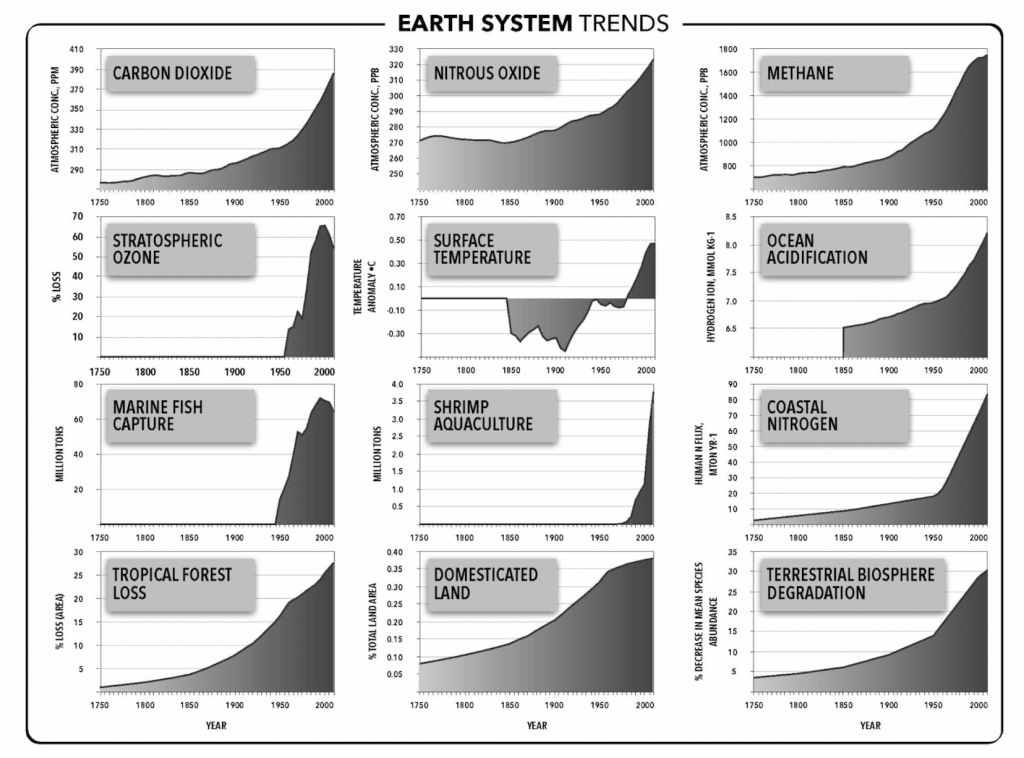
We are now living through and within a new and catastrophic ecological time. Do we call this era the “Anthropocene”, the Age of the Human?
The contemporary ecological crisis was not precipitated by the actions of a generic ‘humanity’ inescapably driven to disrupt biospheric and climatic integrity, but rather by specific and historically contingent social formations and classes. The ruling classes of America and Western Europe are overwhelmingly responsible for the climate crisis, particularly as the beneficiaries of an imperial world-order within which the lands, economies, and bodies of Black, Indigenous, and Global South peoples are subjected to relentless extraction and socio-ecological damage.46
The Anthropocene discourse erases the specific historical reality that conjoined projects of capital, empire, and Western science actively make human and nonhuman natures external, controllable, and objectified for profit, leading to the radical degeneration of habitability and multispecies flourishing.47 The regimes and technologies of capital de-terraform the livable and living Earth.
In this way, the “Anthropocene” language obfuscates socio-historical, political, and ecological reality, posing an abstract “Humanity” as the destroyer of an external, uniform “Nature”. Nevertheless, the term has persisted as the name for our current planetary crisis, and many are attempting to develop Anthropocene discourses, arts, sciences, and political forms that are oppositional to the ways that capital and empire organize human (and also always nonhuman) life-activity.48

The properly dialectical move might therefore be to take up the Anthropocene – both the name and the conjuncture – as a site of extended political struggle; as a way to creatively ply the contradictions of our disastrous times. Ultimately, only an extremely rich and powerful bloc of humans caused the planet to heat by >1°C and wildlife populations to decline by over 70%.50 And yet, the ravaging of the Earth by global capital, Euro-American empire, and Western technoscience has unfolded precisely through a specific Enlightenment ideal of The Human that now exerts control over most humans on the planet.
As philosopher Sylvia Wynter argues, since the mid-15th century, “human” has functionally meant white, European, Christian, heterosexual, male, and rational.51 That individual anthropos (nominally universal but concretely provincial) drives linear Progress through subduing the living world and colonized peoples as instrumental things. Peoples excluded from the empowered category of the Imperial Human were (and are) forcefully consigned to the realm of the subhuman or inert – systematically animalized, pathologized, and exploited as “natural” resources. In the contradictions and socio-ecological disasters of colonial invasion, the exceptionalist Human erupts as a material force of history, debilitating the Earth.52

In a certain rendering, the Anthropocene analytic reinforces a deeply counter-revolutionary view of the human species (and especially Black and Brown humanity) as an aberrant disease infecting the Earth that must be de-populated, eradicated, or self-destroyed for the nonhuman world to survive.54 Justin McBrien attributes this “misanthropic fantasy of a world emptied of ourselves” to the death drive of capital-as-extinction.55
In opposition to this reactionary depiction, we should understand decolonial, anti-imperialist, and socialist struggles as material-symbolic labors to abolish the false universality and false belonging of (colonial) Human supremacy over nonhuman ecologies and all of the working peoples of the Earth. Further, the idea of an absolute equality of moral value between humans and all other species abstracts from these real, ongoing material projects of liberation that simultaneously improve the well-being of humans and nonhuman ecosystems.56
The exceptional Human, ontologically separate from multispecies relations and planetary dynamics, must be humbled (humilis) – rewoven with humus, the living ground of the world. But this can only happen by dismantling the structures of imperial and capitalist domination – through a revolution that forges a new human being, a new collective subject always co-created by and with the entire Earth, which has also been compelled to labor for the rich and powerful.57

Fascist Ascendance
The reactionary wing of the U.S. ruling class has (again) routed popular energy away from the powerful and towards the sexually and racially marginalized, attempting to dismantle the equalizing and protective capacities of the regulatory/administrative state.59 As the Algerian-French anti-colonial theorist Houria Bouteldja writes, white supremacy represents “the last and ultimate recourse of the western bourgeois bloc, which has been shaken from all sides” by interlocking crises.60
Amidst real conditions of deepening social, psychological, and ecological chaos (all intensified by the ruling classes), the global authoritarian upsurge mobilizes a vision of defeating and expelling demonized groups that have “corrupted” or morally degenerated the social order. Such cultural narratives and practices of inter-human alienation energize “preemptive” counter-revolutionary violence and mass murder.
Great masses of people (across disparate classes, not merely the “white working class”) are, when enfolded by potent kinds of exclusionary belonging, willing to attack the institutions and subjects of liberal civilization for the sake of regaining individual vitality and sovereignty.61 These forms of social contagion express historically situated iterations of what Natasha Lennard calls “the fascistic desire to dominate, oppress, and obliterate the nameable ‘other’.“62
The 40+ year neoliberal assault on our responsibility to care for other people has deepened and generalized the social fragmentation, paranoia, and ruthlessly competitive individuality that contribute to reactionary politics.63 Concretely, the “anti-state state” of the neoliberal era contributes to neo-fascist empowerment by minimizing the governmental (and non-governmental) provisions that promote life and livelihoods, while maximizing the ability of the state to surveil, repress, punish, capture, and kill.64
The revival of white nationalist fervor can thus be seen as a strategy for re-stabilizing hegemony amidst capitalist crisis.65 Reactionary ideologies allow the rich to consolidate power, as the threat of a dehumanized enemy legitimates the evisceration of the social wage and the profitable expansion of criminalization and militarization.66
How do we grow the open, participatory belonging that might stem the tide of that “fascistic desire” to unite with (certain) others and regain power by expelling, subordinating, or destroying an inferior group? How do we heal and alleviate that craving for superiority that we are all vulnerable to as social beings traumatized by modernity and conditioned to de-realize the lives of other people?
This reparation process must be collective, politicized, and built from the premise that reversing fascist diversions requires abolishing capitalist immersions, so to speak.67
Growing True Belonging: Of Revolutionary Bonds

“The story that people can be better than others has so far been more compelling than the story that we can be better together. Can we shift that?”
– adrienne maree brown 68
I am not arguing that the primary victims of racial, gendered, and colonial rule are the privileged. Real public, psychological, and economic benefits accrue to certain groups within the context of social domination. I am attempting to demonstrate that we can only gain the advantages of supremacy (like hetero-patriarchy, whiteness, colonial entitlement, human dominance, etc.) by sacrificing the authenticity, connection, and loving relationships that we were born for. The kind of depth and genuine life that most fulfills us, and that promises a better life for future generations.
We should not fight, create, and live for liberation to “save” anyone, but because our freedom cannot be separated from the freedom of all peoples. Our individual interest interpenetrates with the collective interest of all human and nonhuman beings, across the span of difference.
Beyond the sheer indispensability of any social connection to human development, survival, and thriving, belonging names a certain subtle, yet deeply affirming and pleasurable sense of personal congruence or alignment; that cherished sense of “I belong here, I know I am meant to be here and to inhabit this space as much as any other. I belong to these people that I love and care for; to my own calling and to the gifts I offer to the world. Ah, I see – my heart and soul was made for this.”
Can you remember a time when you paused – even for a moment – and felt that sense of incontestable, grounded, and real belonging to and with the alive world? In that space, the preoccupations of a separate, defensive self soften, and we find ourselves remembering that we need each other (no matter what), and are capable of opening our hearts to each other and to the living world.
“De-individuation accompanies intense belonging”, writes Jodi Dean. The isolated individual – the exploited, possessive, and distressed subject of capitalist modernity – dissolves as the site where needs are fulfilled, responsibilities are met, and challenges are surmounted. The reciprocal life-energies of an expansive “We” to which the “I” belongs has the potential to change each person and the world. Equality as belonging gives energy to the longing for justice. And organized political struggle enacts fidelity to the joy of belonging, renewing multi-scalar possibilities for true inclusion within open collectives that are not based on violent exclusion.69
Realizing and re-entering true belonging involves a sense of being aligned with and expressive of our most powerful values, potentials, and visions for a full life together. The practice of just, loving, and accountable relationships – with ourselves, each other, and the planet – generates true belonging. I cannot conceive of a more potent and expansive medicine for an era wracked by apparently endless socio-ecological catastrophe and division.
We must let go of the forms of false belonging that we have adopted out of a desperate craving to be better than others, have more than others, be safer and more privileged than others. The time has come for that particular cultural story to end. The co-creation of justice begins from within as much from without. Redeeming the wounded world requires that we entrust ourselves to our own longing to truly belong, and follow that call home.
“Return with us, return to us,
Be always coming home.”
– (Ursula K. LeGuin)
References
- Political analyses of love and belonging have been innovated by Black feminists especially and the Black Radical Tradition more broadly. This essay draws particularly from adrienne maree brown and john a. powell. ↩︎
- Marx defines the “essence of man” as the “ensemble of social relations” and explains that “The nature of individuals thus depends on the material conditions determining their production.” Marx, K., & Engels, F. (1998). The German ideology: Including theses on Feuerbach and introduction to the critique of Political Economy. Prometheus Books. ↩︎
- Detroit radical Grace Lee Boggs wrote, “Transform yourself to transform the world.” ↩︎
- The overwhelming balance of empirical evidence across multiple fields indicates this. See, for example, Baumeister, R. F., & Leary, M. R. (1995). The need to belong: Desire for interpersonal attachments as a fundamental human motivation. Psychological Bulletin, 117(3), 497-529. doi:https://doi.org/10.1037/0033-2909.117.3.497 ↩︎
- Cf. the Harvard Study of Adult Development, a large and extensive longitudinal study of men from different social classes which found that relationship quality was a better predictor of health and happiness than genetics, wealth, fame, or cholesterol levels. ↩︎
- Stephen Porges, The Polyvagal Theory: Neurophysiological Foundations of Emotions, Attachment, Communication, and Self-regulation ↩︎
- Physician Gabor Maté extends the scientific and theoretical work of attachment theory and interpersonal neurobiology with the framework of “attachment and authenticity” as a “traumatic tension”. The Myth of Normal: Trauma, Illness, and Healing in a Toxic Culture ↩︎
- Many disciplines have developed extensive theoretical, historical, and empirical literature on othering. See: Akbulut N, Razum O. Why Othering should be considered in research on health inequalities: Theoretical perspectives and research needs. SSM Popul Health. 2022 Nov 5;20:101286. doi: 10.1016/j.ssmph.2022.101286. PMID: 36406107; PMCID: PMC9672483. ↩︎
- In The Mushroom at the End of the World (2015), Anna L. Tsing extensively illustrates how capitalist progress depends on alienating living beings from their constitutive, messy entanglements and recasting them as infinitely scalable objects. ↩︎
- In essence false belonging upholds what Antonio Gramsci understood as ‘cultural hegemony’, the consent by the masses to be ruled by capital. ↩︎
- The paradigm of a ‘world-ecological regime’ and maximally low-cost work/energy as constitutive of the capitalist law of value has been developed by Jason W. Moore and Raj Patel. ↩︎
- See especially the work of Arun Kundnani, Olúfẹ́mi O. Táíwò, and Ruth Wilson Gilmore. ↩︎
- Jodi Melamed. (2015). Racial capitalism. Critical Ethnic Studies, 1(1), 76. https://doi.org/10.5749/jcritethnstud.1.1.0076
↩︎ - Robinson, C. J. (2000). Black Marxism: The Making of the Black Radical Tradition. University of North Carolina Press.
↩︎ - Menakem, R. (2021). My grandmother’s hands: Racialized trauma and the pathway to mending our hearts and Bodies. Penguin Books.
↩︎ - Institute for Moral Injury ↩︎
- DuBois, W. E. B., Foner, E., & Gates, H. L. (2021). Black reconstruction: An essay toward a history of the part which Black Folk played in the attempt to Reconstruct Democracy in America, 1860-1880, & other writings. The Library of America.
↩︎ - Bouteldja, H., & Valinsky, R. (2024). Rednecks and barbarians: Uniting the white and racialized working class. Pluto Press.
↩︎ - Changing the interior and interpersonal structures of whiteness matters, but the hegemonic liberal system construes justice as essentially an individualized, de-politicized process of acting more tolerably under conditions that are still oppressive and morally abhorrent. ↩︎
- Gilmore, R. W. (2022). Forgotten Places and the Seeds of Grassroots Planning. In Abolition Geography: Essays Toward Liberation (pp. 410–449). essay, Verso.
↩︎ - A recent study indicated that the more that men comply with normative forms of masculinity, the more likely they are to commit suicide: Genuchi MC. Broadening the Perspective on the Dynamics of Men’s Suicide: Thought Suppression as a Mediator between Men’s Self-Reliance and Suicidality. Arch Suicide Res. 2024 Jan-Mar;28(1):324-341. doi: 10.1080/13811118.2023.2173114. Epub 2023 Mar 12. PMID: 36908198. ↩︎
- For a deeper exploration see hooks, bell. (2004). The will to change: Men, masculinity, and Love. Washington Square Press.
↩︎ - ibid, p. 4 ↩︎
- “Measuring unpaid domestic and care work” – ILOSTAT. Available at: https://ilostat.ilo.org/topics/unpaid-work/measuring-unpaid-domestic-and-care-work/ ↩︎
- Federici, S. (2021). Caliban and the Witch: Women, the body and primitive accumulation. Penguin Books.
↩︎ - According to the International Labor Organization, 50% of all workers on Earth are service workers. In richer nations, the majority of workers are servants. Also see Dean, J. (2025). Capital’s Grave: Neofeudalism and the new class struggle. Verso.
↩︎ - Gryn, T. Married couple households made up most of family households. Census.gov. https://www.census.gov/library/stories/2023/05/family-households-still-the-majority.html ↩︎
- Lewis, S. (2022). Abolish the family: A manifesto for care and liberation. Verso. & Barrett, M., & McIntosh, M. (1982).The anti-social family. Verso.
↩︎ - Raha, N. (2021). A Queer Marxist Transfeminism: Queer and Trans Social Reproduction. In Transgender Marxism (pp. 85-116). essay, Pluto Press. ↩︎
- Lewis, S. (2021). Full surrogacy now: Feminism against family. Verso. & Dean, J. (2025). Capital’s Grave: Neofeudalism and the new class struggle. Verso. ↩︎
- https://journals.lww.com/wpsy/fulltext/2020/02010/the_global_south__an_emergent_epistemology_for.4.aspx ↩︎
- The Exhausted of the Earth, by ↩︎
- See https://theintercept.com/2019/08/25/border-patrol-israel-elbit-surveillance/ and https://prismreports.org/2024/07/22/elbit-systems-israeli-apartheid-us-border/ ↩︎
- A History of the World In Seven Cheap Things, p. 55 ↩︎
- See the indispensable work of Robin Wall Kimmerer on mutual and multispecies flourishing. ↩︎
- See Winona LaDuke on the “wendigo economy” – https://www.winonaladuke.com/news/wagingnonviolence ↩︎
- See https://monthlyreview.org/2018/01/01/settler-colonialism-and-the-second-amendment/ ↩︎
- Dussel, Philosophy of Liberation, 52–53, translation modified; Filosofía de la liberación, 69–70. ↩︎
- See Ciccariello-Maher, G. (2017). Decolonizing dialectics. Duke University Press. Maher’s section on Fanon gives a powerful account of this kind of decolonial dialectic. ↩︎
- Ibid ↩︎
- Ruth Wilson Gilmore, preface to Imperialism and the National Question ↩︎
- See https://en.wikipedia.org/wiki/Holocene ↩︎
- See McNeill, J. R., & Engelke, P. (2016). The great acceleration: An environmental history of the anthropocene since 1945. Harvard University Press. They state: “The entire life experience of almost everyone now living has taken place within the eccentric historical moment of the Great Acceleration.” ↩︎
- Parenti, C., Crist, E. C., McBrien, J., Haraway, D. J., Altvater, E., Hartley, D., & Moore, J. W. (2016). Anthropocene or capitalocene?: Nature, history, and the crisis of capitalism. Pm Press.
↩︎ - Ibid ↩︎
- For cumulative CO2 emissions statistics, see: https://ourworldindata.org/contributed-most-global-co2. Note that Euro-American consumption also drove much of the use of China as a fossil fuel-intensive manufacturing hub. ↩︎
- Moore, J. W. (2016). Capitalism in the web of life: Ecology and the accumulation of capital. Verso. & Blake, J. S., & Gilman, N. (2024). Children of a modest star: Planetary thinking for an age of crises. Stanford University Press.
↩︎ - For example, see the incredible work of Anna L. Tsing and others through the digital project “Feral Atlas: The More-Than-Human Anthropocene” https://feralatlas.org/ ↩︎
- See Cable News Network. (2021, May 18). Half of single-use plastic waste produced by just 20 companies | CNN business. CNN. https://www.cnn.com/2021/05/18/world/single-use-plastics-scli-intl/index.html and Break Free From Plastic. (2024, October 8). Study by European University blames Global South for plastic pollution, overlooks the role of plastic industry and waste trade. https://www.breakfreefromplastic.org/2024/09/06/european-study-blames-global-south-for-plastic-pollution/
↩︎ - See https://www.climate.gov/news-features/understanding-climate/climate-change-global-temperature and https://www.worldwildlife.org/press-releases/catastrophic-73-decline-in-the-average-size-of-global-wildlife-populations-in-just-50-years-reveals-a-system-in-peril ↩︎
- Wynter, S. (2003). Unsettling the coloniality of being/power/truth/freedom: Towards the human, after man, its overrepresentation–an argument. CR: The New Centennial Review, 3(3), 257–337. https://doi.org/10.1353/ncr.2004.0015
↩︎ - Tsing, A. (2016). Earth stalked by man. The Cambridge Journal of Anthropology, 34(1). https://doi.org/10.3167/ca.2016.340102
↩︎ - Underhill, V., Sabati, S., & Beckett, L. (2022). Against settler sustainability: California’s groundwater as a vertical frontier. Environment and Planning E: Nature and Space, 8(1), 189–208. https://doi.org/10.1177/25148486221110434 ↩︎
- A shocking number of popular films and television shows essentially conclude with the reactionary lesson that all humans are a cancer to be cleansed from the Earth. ↩︎
- McBrien, J. (2016). Accumulating Extinction: Planetary Catastrophism in the Necrocene. In Anthropocene or Capitalocene: Nature, History, and the Crisis of Capitalism (116-138). essay, PM Press. ↩︎
- Engel-De Mauro, S. (2021). Socialist states and the environment: Lessons for Ecosocialist Futures. Pluto Press.
↩︎ - The revolutionary and psychiatrist Frantz Fanon describes national liberation struggles as creating a “New Man” free from the European civilizing project. ↩︎
- See https://www.newsocialist.org.uk/agroecology-and-cuban-socialism/ ↩︎
- See the recent (2025) articles and publications of the Party for Socialism and Liberation on this point.
↩︎ - Bouteldja, H., & Valinsky, R. (2024). Rednecks and barbarians: Uniting the white and racialized working class. Pluto Press. ↩︎
- Seymour, R. (2024). Disaster nationalism: The downfall of liberal civilization. Verso Books.
↩︎ - Lennard, N. (2019). Being numerous. Verso.
↩︎ - Seymour, R. (2024). Disaster nationalism: The downfall of liberal civilization. Verso Books. ↩︎
- See Gilmore, R. W., Bhandar, B., & Toscano, A. (2023). Abolition geography: Essays towards liberation. Verso. and The revolution will not be funded: Beyond the non-profit Industrial Complex. (2017). Duke University Press. ↩︎
- Toscano, A. (2023). Late fascism: Race, capitalism and the politics of crisis. Verso.
↩︎ - Gilmore, R. W., Bhandar, B., & Toscano, A. (2023). Abolition geography: Essays towards liberation. Verso. ↩︎
- Bertolt Brecht wrote, “Fascism can be combated as capitalism alone, as the nakedest, most shameless, most oppressive, and most treacherous form of capitalism.” From Bertolt Brecht (1935). Writing the truth: Five difficulties. Translation by Richard Winston, for the magazine ‘Twice a Year’. Collected in William Wasserstrom, ed., Civil Liberties and the Arts: Selections from Twice a Year, 1938-48. Syracuse University Press, 1964. ↩︎
- How to Survive the End of the World ↩︎
- Dean, J. (2018). Crowds and Party. Verso. ↩︎
 Fractals of Liberation
Leave a comment